

PlanetF1's Hall of Fame: Ayrton Senna – The father, son and Holy Ghost of F1
In that location is no shortage of poignant images from Ayrton Senna da Silva's final 24 hours on Earth.
Unremarkably the offset to come to heed is that of Senna sitting uncomfortably in his cockpit, helmet off, on the filigree at Imola – a man silently wrestling with his own fate, every sinew urging him to walk abroad but deep downwards knowing he must go on.
The anguish spreading across his tormented face up equally he witnessed the horror of Roland Ratzenberger'south fatal accident from the Williams garage is never far behind, nor is the sight of Senna stood arms folded, deep in conversation with Sid Watkins at the crash site minutes later.
Perhaps the most haunting of all, though, is a piece of amateur footage filmed from the spectator bank at the Tosa hairpin. The original clip has long been lost to the bowels of the cyberspace, only stands equally Formula 1'southward equivalent of the Stations of the Cross.
Information technology tells the tale of the end of Senna's life across three laps – 3 acts – the first beginning behind the Safety Motorcar following the commencement-line crash at the 1994 San Marino Chiliad Prix.
Then it cuts to the first racing lap, Senna's Williams shadowed past Michael Schumacher'due south Benetton as the cars accelerate out of Tosa, the piercing roar of the V10 engines only augmented by a joyous blaze of thank you, shouts and airhorns.
This is racing, this is life.
After life comes decease and every bit Senna'south car skids to a halt in the distance post-obit the affect at Tamburello, a single airhorn sings almost mournfully as the soundtrack to the demise of the world'southward greatest racing commuter.
A part of Formula i died with Senna that twenty-four hours and its history can be finer split into two Testaments – before Imola '94 and after.
From Senna'south death, broadcast alive to millions on worldwide tv, came a multitude of safety measures many take for granted today, from expansive run-off areas and enhanced barrier applied science to cycle tethers, higher cockpit sides and halos.
He is the father, son and Holy Ghost of Formula 1 – his decease immune others to live – only information technology is a reflection of the banner Senna left on the sport that his memory still far outweighs the impact of his expiry.
To telephone call Senna a complex character would almost practise him a disservice. Think of all the complex characters to have graced sport through the generations and Senna, with that soft way of speaking and that permanently pensive facial expression, is notwithstanding more compelling.
All human life was hither and in that location was, as the former Times main sportswriter Simon Barnes observed, "in Senna something of the quality that made saints a few centuries back: that certainty, that sense of destiny."
Sport tin mean many things to many different people. Arrigo Sacchi, the swell Italian football manager, famously called it the near important of the least of import things.
Senna stood alone in making his chosen sport seem a quest for the significant of life. A more than intense pair of optics through the visor of a helmet y'all will never encounter.
Every race was an opportunity to learn more than almost life, well-nigh himself – the most vivid lessons of all, perhaps, coming over the weekend of the 1988 Monaco Grand Prix.
Senna's fourth dimension for pole position, about ane.5 seconds quicker than Alain Prost in the same car, was not so much the perfect lap as the discovery of motor racing'south Holy Grail.
His arresting description of the lap as an out-of-body experience – "I was in a different dimension… well beyond my conscious understanding" – was something only he could deliver and added to the allure.
But was it something far more tangible, far more man than that?
Was information technology really anything more, anything less, than someone falling into a land of total repose where every decision and every movement becomes effortless and instinctive? Was information technology and so much dissimilar to a mere mortal driving on the road and suddenly realising they have no recollection of the last v minutes of the journey?
If the everyday magic of the Monaco pole was Senna's superlative the following day, as he gifted the victory to Prost by crashing at Portier while leading past close to a infinitesimal, was yet more instructive.
Modern sport is full of people who vow to never make the same fault twice, talking the talk simply detect the walk a more than challenging task altogether.
There is no greater tribute to Senna's delivery to cocky-improvement than the fact that after disappearing to his nearby apartment to stew in his shame, he would win six of the next eight races to form the spine of his first World Championship.
As for Monaco? He would never be browbeaten there again.
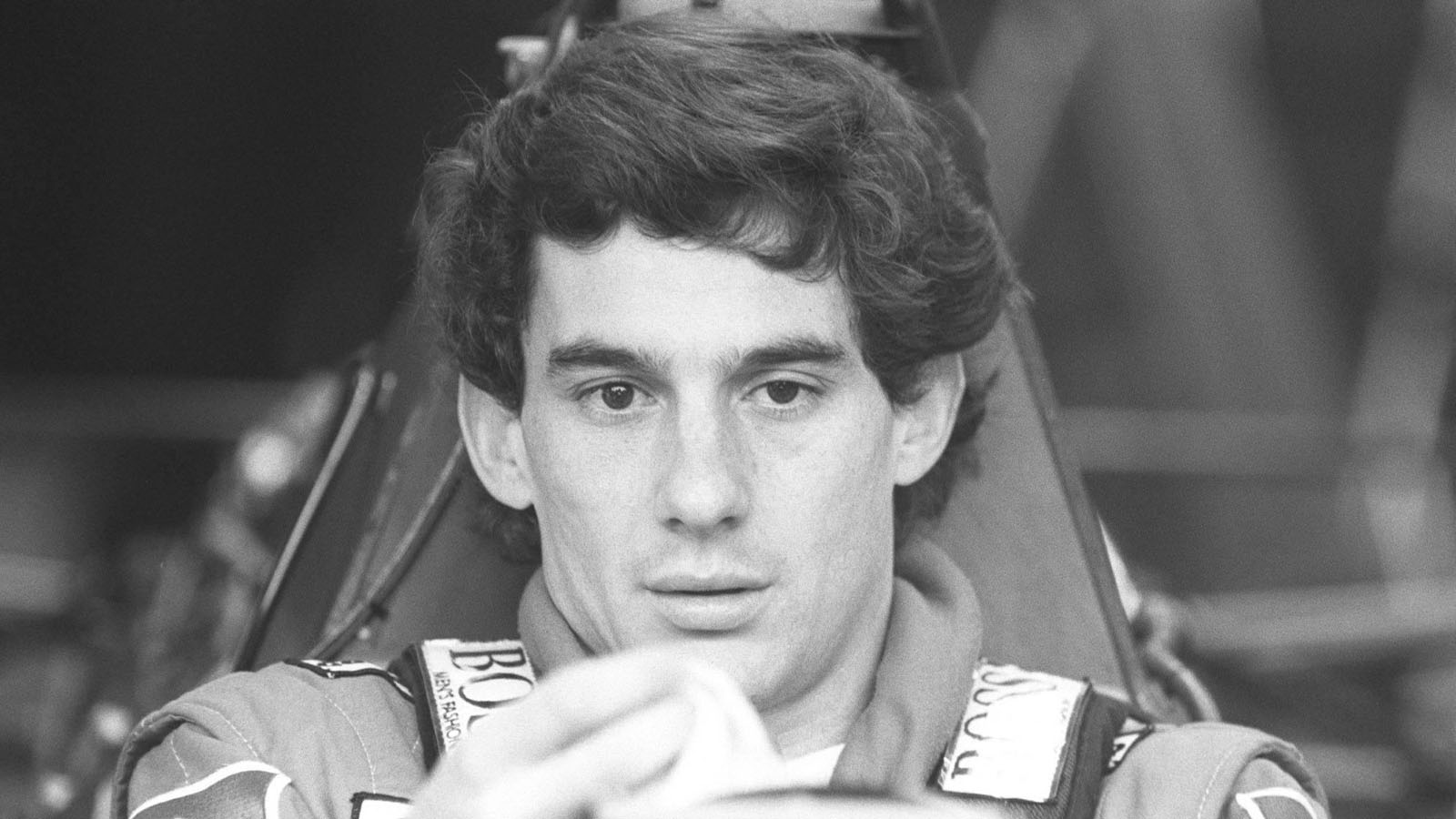
Senna would subsequently claim Monaco '88 brought him closer to God and his spirituality – combined with a combativeness on runway that came as a civilisation shock to an older generation of drivers who had it drilled into them that contact with another car was racing's deadliest sin – became both his sword and shield.
He may have rejected Prost's sniggering suggestion that considering he believed in God he didn't think he could kill himself, insisting he was as vulnerable and scared as anyone of getting hurt, but in such situations it is the perception of one'south peers that matters most.
Would you willingly get bike to bicycle with a man whom you lot suspected was sure they would be protected past God no matter what? Would you trust him, potentially put your life in his hands?
Senna's rivalry with Prost was a cocktail of contrasts – heart versus head, artist versus pragmatist – and just as they challenged one another to accomplish even greater heights, so they tore each other down.
Equally the outstanding driver of the generation, Prost felt Senna had targeted him from the moment they met properly for the start time at the 1984 Race of Champions.
"He never wanted to beat me, he wanted to humiliate me," Prost says in the 2010 flick on Senna'south life. "He wanted to show the people that he was much stronger, much better and that was his weakness."
Senna's death and the subsequent documentary have combined to create another dissimilarity – hero versus villain – however despite his perception that he was fighting a two-headed monster in Prost and FIA president Jean-Marie Balestre, Ayrton was no angel either.
It was he who took advantage of the confusion of a red-flag stoppage to break a pre-race understanding with Prost at Imola; it was he who edged Prost towards the pit wall at Estoril; it was he who took his team-mate out at Suzuka in a motility infinitely more dangerous than Prost's on him 12 months earlier.
Yet it was likewise he who stood distressed at the site of Martin Donnelly's virtually-fatal crash at Jerez; information technology was besides he who sprinted beyond the track at Spa to save the life of Erik Comas; it was too he whose behaviour towards Prost transformed the second he ceased to exist a threat.
Considering what was to come up, the closure of his radio bulletin to a retired Prost before the clouds gathered at Imola 1994 – "we all miss you lot Alain" – was profoundly poignant.
What, it is oftentimes tempting to wonder, must Senna accept been thinking every bit he saturday on the grid, eyes shut, the following afternoon?
For the answer, if we are to accept Ron Dennis's conventionalities that even had he known his fate he would not have inverse a matter, perhaps we should retrace the steps to Senna's stream of consciousness in the aftermath of the Donnelly accident…
"A meg things went through my mind and in the end I realised I was not going to requite up my passion, simply having seen what I had seen. And I had to pull myself together and walk out, go to the racing automobile and exercise it once again – and do information technology even better than earlier.
"Because that was the way to cover the touch that had on me. I was but non ready to requite up. As much as I was scared to continue, I was non ready to surrender my aim, my target, my objective, my passion, my belief, my life.
"It is my life."
Other PlanetF1 Hall of Fame entrants
Michael Schumacher
Source: https://www.planetf1.com/features/planetf1-hall-of-fame-ayrton-senna/
Posted by: carswellkinces.blogspot.com
0 Response to "PlanetF1's Hall of Fame: Ayrton Senna – The father, son and Holy Ghost of F1"
Post a Comment